
Thrivent Financial
Marriage Vitality Platform
Exploring current and future needs of married couples
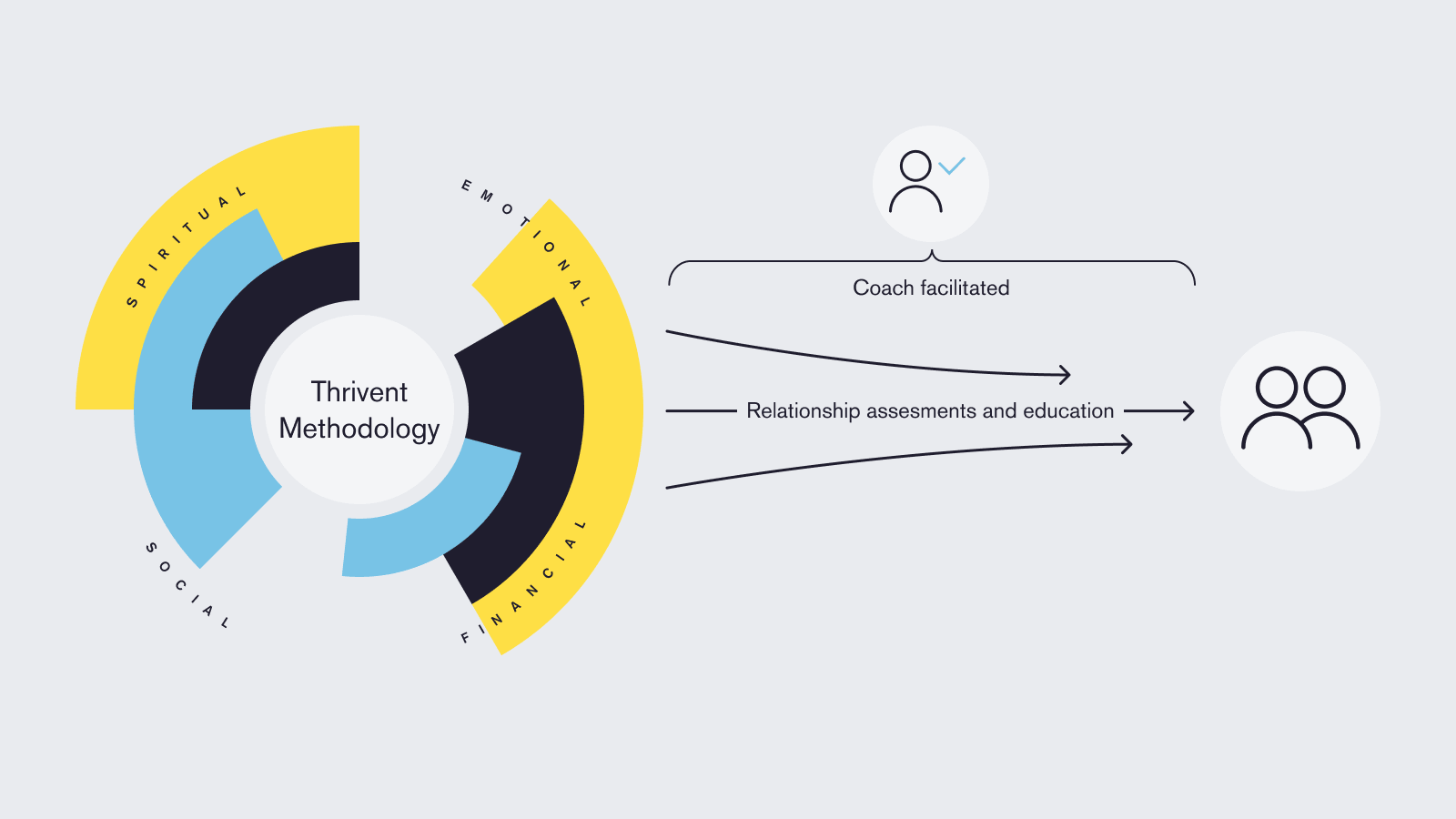
Overview
Marriage is one of the most complex relationships humans navigate. Most support systems treat it like it isn’t.
Thrivent asked whether a financial services organization could meaningfully support the marriages of its member-owners. I led the effort to find out.
Role
Lead service designer
Methods & artifacts
Field research
Workshop facilitation
Service design
Prototypes
User stories
Moderated user testing
Field Research
Listening to marriages from the inside — and the support networks around them
To understand what married couples actually need, not what a financial services company assumed they needed, we conducted interviews across three cities, deliberately chosen to capture geographic, cultural, and demographic range.
Crucially, we didn't just speak with couples. Advisors and pastors, the people couples already turn to in moments of relationship stress, provided a view of the support landscape that interviews with couples alone couldn't provide. Divorced individuals offered something rarer still: an honest account of what support was absent when it was most needed.
Minneapolis, MN
11
5 married couples, 1 engaged couple, 2 divorced individuals, 1 advisor, 2 pastors
Orange County, CA
12
5 married couples, 1 engaged couple, 2 divorced individuals, 2 advisors, 2 pastors
Atlanta, GA
13
7 married couples, 1 engaged couple, 3 advisors, 2 pastors
Synthesis
From 30+ conversations to a shared picture of what marriages need
The field data was translated into personas and journey maps representing distinct user groups, couples at different stages and with different needs, and the coaches and advisors who support them. These artifacts weren’t just deliverables. They became the team's shared language during product decision-making, letting us debate tradeoffs with a specific person in mind rather than an abstraction.
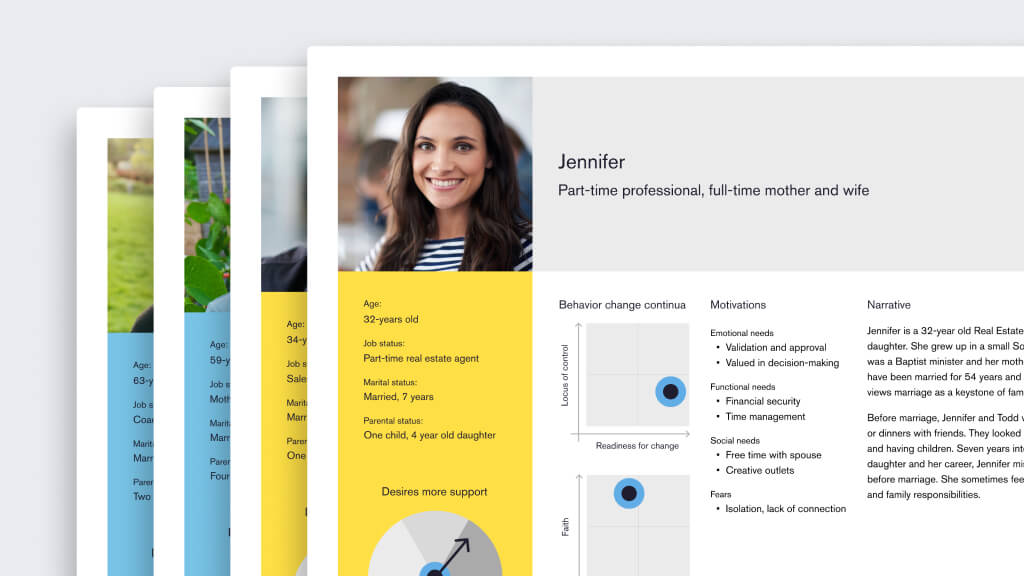
Personas captured distinct relationship stages, support needs, and attitudes toward seeking help, grounded in field research across three cities.
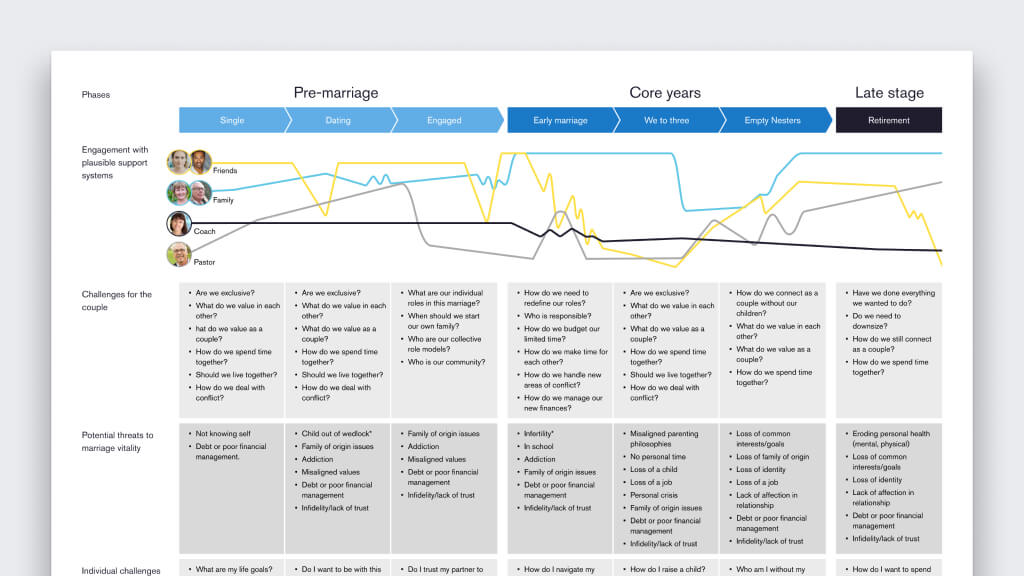
Journey maps traced the arc of a marriage, from early partnership through challenge and, for some, dissolution — identifying where support was absent or arrived too late.
What we found
Two problems that shaped everything
The field data was translated into personas and journey maps representing distinct user groups, couples at different stages and with different needs, and the coaches and advisors who support them. These artifacts weren't just deliverables. They became the team's shared language during product decision-making, letting us debate tradeoffs with a specific person in mind rather than an abstraction.
1
No single support system can make a marriage strong
Marriage is too complex and too personal for any one intervention. The most resilient couples drew on multiple sources of support — faith communities, financial advisors, therapists, peers — and moved between them as their needs changed. A product that tried to be all of those things would fail to be any of them.
2
Existing support networks are under-equipped
Pastors, advisors, and family members — the people couples most readily turn to — often lacked the tools, training, or time to respond to the complexity of what they were being asked. The gap wasn't absence of support; it was inadequacy of the support that existed.
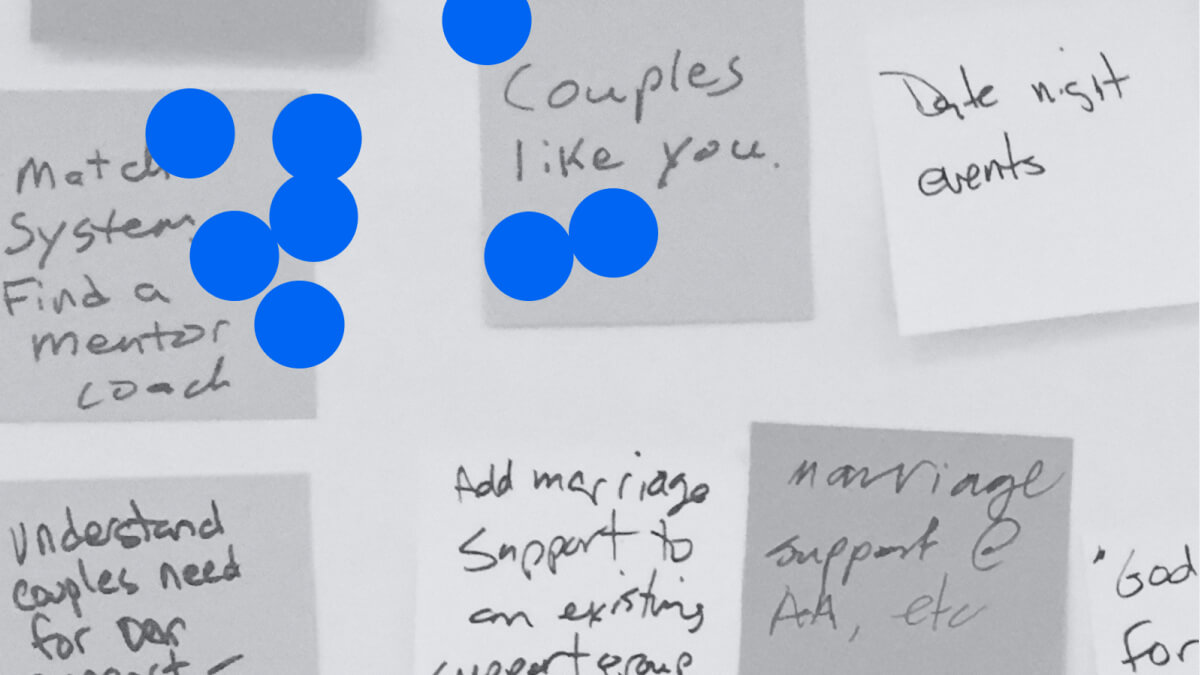
Stakeholder co-design sessions used dot voting to align on which problems were worth solving and which opportunities were both viable and desirable.
Framework & design
A service model built around coaches — not content
The two findings pointed toward the same conclusion: the platform's highest-value role wasn't to replace existing support, but to strengthen the coaches and advisors already in couples' lives while giving couples a direct channel for engagement between sessions.
We designed a service model optimized for three groups: couples seeking support, coaches building a practice, and the trusted network around each couple. Thrivents's faith-based values were integrated as a design constraint — not a feature to bolt on, but a lens that shaped tone, language, and what the platform chose not to do.
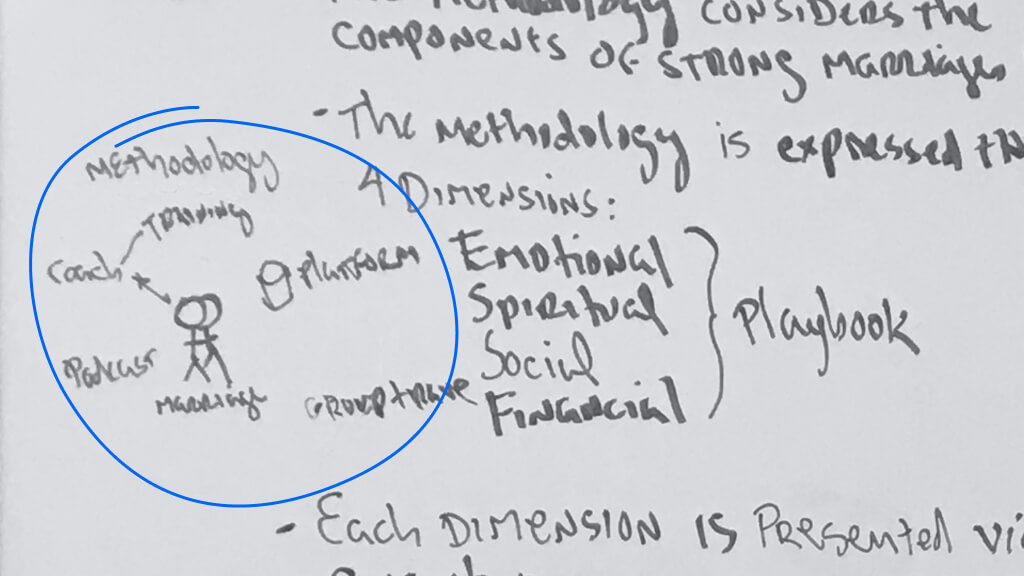
Framework mapping jobs-to-be-done across couples, coaches, and support networks — the structural foundation for all feature decisions.
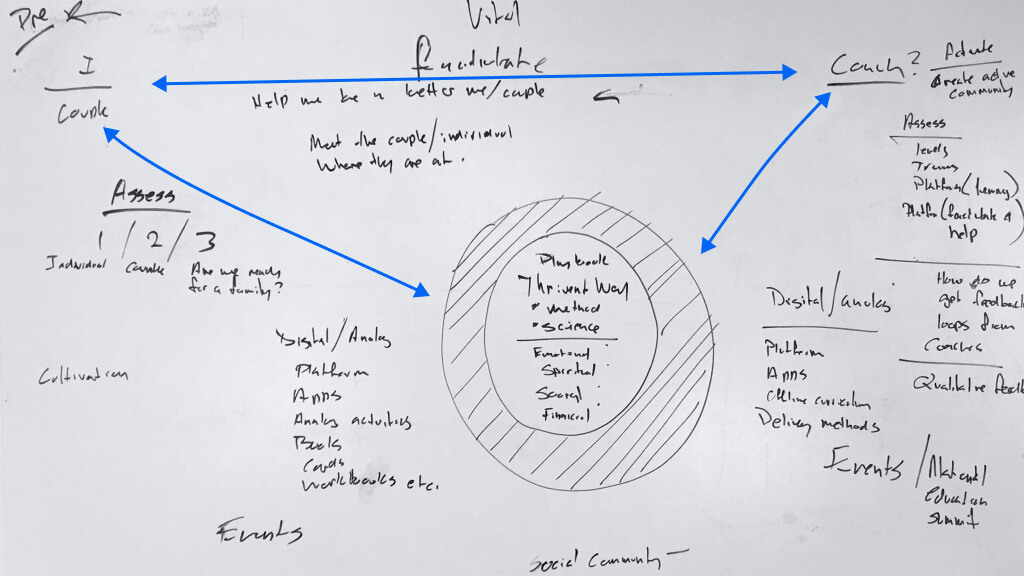
Whiteboard sessions with translated research findings into a coherent service structure before any interface design began.
Prototyping & Testing
Testing with both sides of the relationship
We ran separate testing tracks with couples and coaches, each with different questions and different success criteria. Couples told us whether the product would actually be used during the hard moments of a marriage, not just the motivated ones. Coaches told us whether it could realistically integrate into their practice without creating more work than it removed.
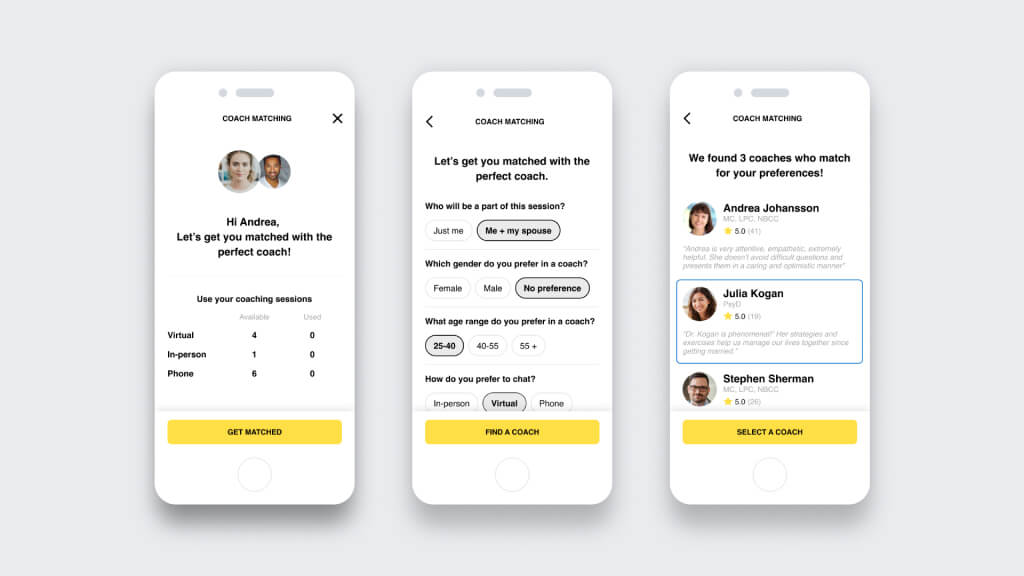
Couples choose a coach whose profile and credentials match their needs — the matchmaking flow designed to surface fit, not just availability.
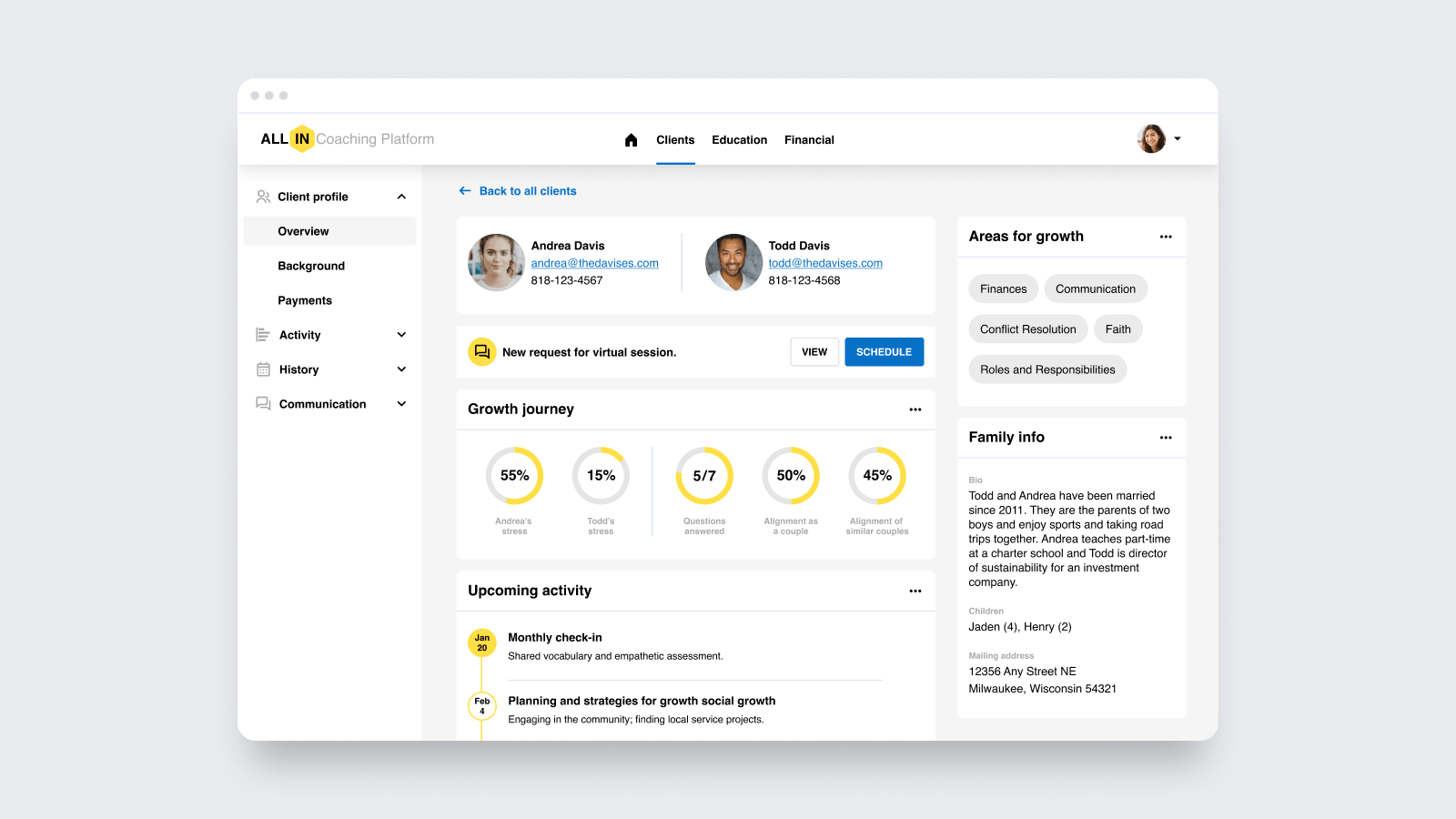
The coach-side platform gave practitioners a single view of client engagement, upcoming appointments, and areas where a couple needed additional support.
Coach user stories
Synthesized feedback in the coach’s voice
After prototype testing with coaches, we translated their feedback into user stories — a format that helped the client team understand unmet needs and potential adoption barriers without wading through raw session notes.
–
Acquiring clients
When I want to understand a couple's needs, I want to build a coaching program specifically for them — so that my approach is grounded in their situation from the first session.
–
Referring couples
When a couple needs support beyond my scope, I want access to a trusted network of coaches and counselors — so that I can refer with confidence rather than leaving them without a path forward.
–
Managing resources
When I'm preparing for a session, I want easy access to a curated resource library — so that I can focus my energy on coaching rather than searching for materials.
–
Tracking progress
When I want to check in between sessions, I want insight into a couple's program engagement — so that I can prompt and guide them before we meet, not after.
Outcomes
A validated service model and a clear path to pilot.
–
Service model validated
Research and testing confirmed both the need and the direction — a credentialed coaching platform grounded in couples' actual support gaps.
–
Prototype tested with real users
Both couples and coaches engaged with working prototypes — providing specific, actionable feedback on features and fit.
–
User stories socialized
Coach user stories gave the client team a concrete, shareable view of what ongoing development needed to prioritize.
–
Roadmap defined
Next steps included a pilot program with a select couple group, peer-to-peer support features, and EMR integration for clinically adjacent use cases.
Reflection
The hardest part of this project wasn’t the research or the design, but was maintaining focus on a product whose subject matter is genuinely sensitive. Couples talked about struggles they hadn’t shared with anyone outside the room. That trust came with a responsibility to represent their experiences accurately and to advocate for their needs when business priorities threatened to abstract them away. The user stories at the end of the project weren’t just a synthesis tool; they were a way of keeping real people in the room when conversations turned to features and roadmaps.